
October 4, 2026
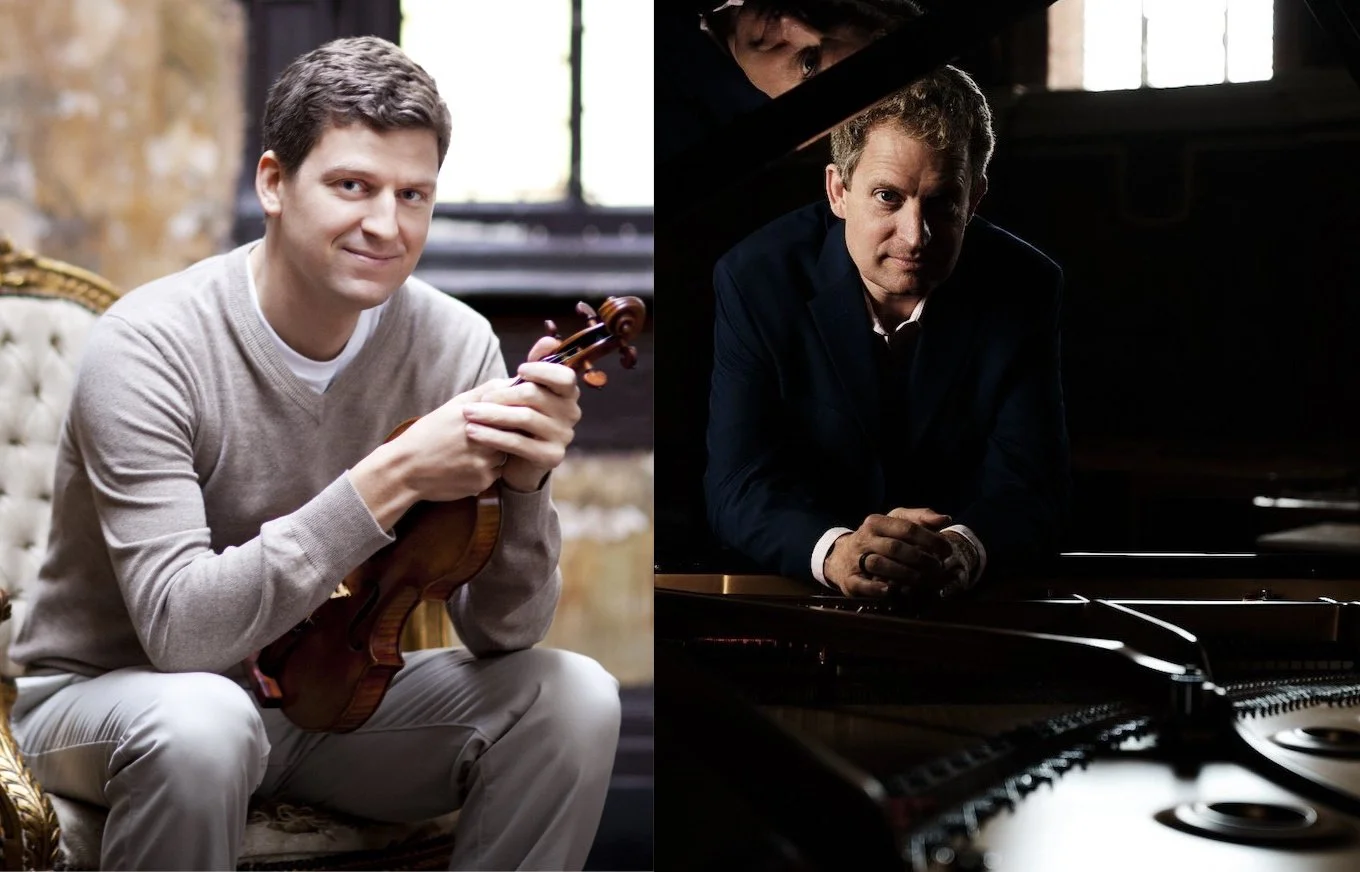
James Ehnes &
Andrew Armstrong
Violin & piano
James Ehnes © Benjamin Ealovega
Andrew Armstrong © Benjamin Ealovega
Biography
“Playing of phenomenal control allied to musicianship of the highest order,” declared The Times of London about violinist James Ehnes. He has performed in over thirty countries on five continents, appearing regularly in the world’s great concert halls with many of the most celebrated orchestras. Ehnes made his professional orchestral debut with the Montreal Symphony at the age of thirteen. His extensive discography includes over forty recordings of music from Bach to Adams. These have won numerous awards, including twelve Junos, the most of any classical musician in history. His many awards and prizes include the first-ever Ivan Galamian Memorial Award and the Virginia Parker Prize from the Canada Council for the Arts. In 2007 he became the youngest person ever elected as a Fellow to the Royal Society of Canada. In 2010 the Governor General of Canada appointed Ehnes a Member of the Order of Canada. During the 2025-2026 season, with pianist Andrew Armstrong he undertook his 50th birthday recital tour through every province and territory of his native Canada. He plays the 1715 “Marsick” Stradivarius. 9th LMMC concert.
Andrew Armstrong has delighted audiences and amazed critics across five continents for his passionate expression and dazzling technique. His orchestral repertory alone comprises more than sixty concertos. Last fall, Armstrong launched his first music festival in Tuscany, Italy, a festival combining music with wineries, castles and truffle hunts. With his longtime recital partner Ehnes he has made numerous recordings, including the complete Beethoven sonatas, the complete Bartók music for violin and piano, and, most recently, the Brahms sonatas. 3rd LMMC appearance.
https://www.jamesehnes.com/
https://www.andrewarmstrong.com/
Notes
Norwegian-born Christian Sinding spent most of his career in Germany. Hence, unlike Grieg, much of his music sounds more Germanic than Nordic. The first movement of the Suite in A minor (1888) is brief, but packs into its two minutes a flurry of notes that fly by in perpetual motion. The second movement is a heartfelt, vocally-inspired Adagio, while the third is dancelike in character and brings vaguely to mind the Bach solo violin sonatas and partitas. The use of numerous double and triple stops as well as the independence of the solo part (the piano accompaniment is virtually superfluous) further recall “the olden style” of Bach.
Brahms’s Third Violin Sonata, completed in 1888 (like Sinding’s Suite), is generously filled with warmth, lyrical richness and melodic enchantment. The sonata is in four movements instead of the usual three. The first is dominated by the long, soaring, impassioned theme that opens the work. Passages of lyric beauty and restless agitation fill the pages. The second movement is contemplative and evokes the epithet often applied to works of Brahms’s later years, “autumnal.” This movement, like the first, is built predominantly from a single theme. The third movement is imbued with a light, deft touch, and trips along merrily. The exuberance and youthful vitality of the final movement recall the Brahms of earlier years. There are three themes, each with its characteristic mood.
Yellowknife-based Carmen Braden has been called “acoustic ambassador of the Canadian Subarctic” (Musicworks). She says of her Imaginal, premiered in Kingston, Ontario last May and receiving its Quebec premiere today: “How caterpillars become butterflies is crazier and more inspirational than I ever knew! Their bodies disintegrate inside the cocoon into a kind of goo and then are rebuilt into a new form that is bewilderingly different than the old. Special cells called ‘imaginal’ cells are the catalysts for this transformation. In Imaginal, a core melody woven throughout the piece goes through many takings-apart and putting-back-togethers. … If there’s anything that’ll hold us together in this crazy world, it’s music, friends, curiosity and caterpillars.” Imaginal was written for James Ehnes and was co-commissioned by nearly a score of performing arts venues across Canada, with the Northern Arts and Cultural Centre in Yellowknife as lead commissioner.
Bartók composed both of his Rhapsodies for violin and piano in 1928, between the Third and Fourth String Quartets. The fruits of his labor in collecting on cylinder phonograph the folksongs and dances of Hungary and Romania can be heard to full advantage in both Rhapsodies. Into the first he incorporated half a dozen different folk tunes, beginning with the lusty, swaggering opening theme of the lassú (slow piece) and proceeding to the madly swirling final theme of the friss (fast piece). Throughout, Bartók evokes images of country fiddlers, peasant villages and rustic landscapes.
Robert Markow
Programme
SINDING Suite in the Old Style in A minor,
(1856- 1941) Op. 10 (1888)
BRAHMS Violin Sonata No. 3 in D minor,
(1833-1897) Op. 108 (1888)
BRADEN Imaginal (2026)
(1985 - )
BARTÓK Rhapsody No. 1 for Violin and Piano,(1881-1945) Sz. 87 (1928)
Intermusica
-
Downloads
-
Next Concert
Lucas Debargue, piano
October 25, 2026 at 3:30 p.m.