
November 15, 2026
Quatuor Hanson &
Lise Berthaud
Strings & viola
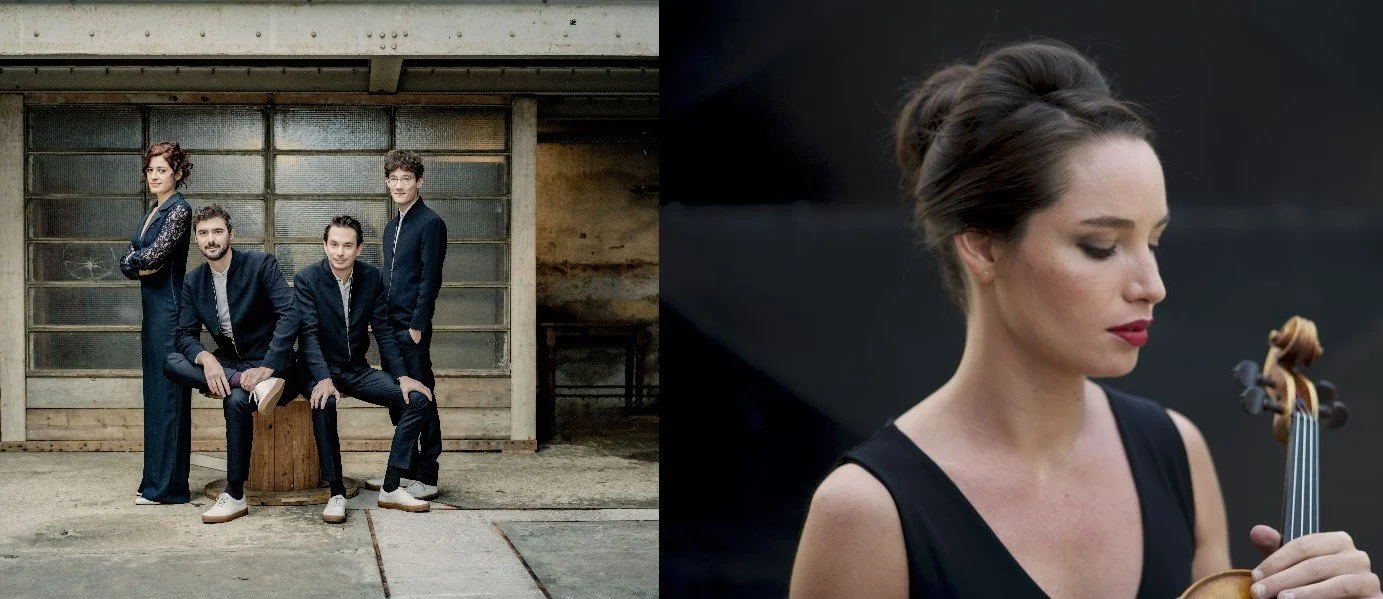
Quatuor Hanson © Marco Borggreve
Lise Berthaud © Marie Rolland
Biography
Anton Hanson, Jules Dussap - violins
Gabrielle Lafait - viola
Simon Dechambre - cello
and
Lise Berthaud, viola
The Quatuor Hanson is a highly acclaimed string quartet formed in Paris in 2013. It is known for its dynamic interpretations of the core repertory while also embracing contemporary composers like Toshio Hosokawa, Matthias Pintscher, and Wolfgang Rihm. The Quartet specializes in Haydn, and its debut recording of Haydn quartets on the Aparté label won a Diapason d’Or. The Quartet takes its name from its first violinist, UK-born Anton Hanson. Supported by both the Fondation Banque Populaire and the Fondation Singer-Polignac, where they are in residence in Paris, the four musicians have won many international competitions, including third prize and the audience prize at the Lyons Competition in 2015, second prize in Geneva in 2016, and second prize at the Joseph Haydn Competition in Vienna, where they were awarded several special prizes (Haydn Prize, Audience Prize and Best interpretation of a 20th-century work). LMMC debut.
The Quartet is joined by French violist Lise Berthaud. Berthaud began violin lessons at the age of five, and early on switched to viola at the age of twelve. She has worked with several major contemporary composers including Philippe Hersant, Thierry Escaich, Henri Dutilleux, György Kurtág and Guillaume Connesson. In September 2013, she was selected to be part of BBC Radio 3’s New Generation Artists scheme, and in October her first recording as a soloist with pianist Adam Laloum appeared; this was awarded several prizes, including the prestigious Diapason d’Or. LMMC debut.
https://quatuorhanson.com/en/home/
https://www.musicaglotz.com/musiciens/lise-berthaud/
Notes
Mozart wrote his first string quintet (K. 174) in 1773 at the age of seventeen. After that he did not return to the medium for fourteen years, which in his short career meant the difference between a teenage miracle and a composer at the pinnacle of artistic maturity. The Quintet in C major, K. 515, along with its companion in G minor, K. 516, dates from 1787. All six of Mozart’s string quintets employ two violas. His fondness for this instrument, with its deep tone and rich, warm sound, is seen in the care with which he treats it in orchestral writing as well, where we find, increasingly as his life progresses, the tendency to write for divided viola sections, thus further exploiting its tone colour. In K. 515 Mozart combined emotional depth, technical assurance, contrapuntal mastery, the broad scope of the symphony, and even elements of the concerto and opera in his handling of the five independent parts.
Brahms composed his Second String Quintet in 1890 in the lovely resort town of Bad Ischl, nestled among forests, lakes and mountains. Nevertheless, his mood was filled with melancholy and the spectre of old age. He was only fifty-seven, yet he told his publisher Simrock that he could expect no more compositions from him. Happily for posterity, Brahms lived another seven years and produced a dozen more works. But even if Brahms had kept to his word, the Quintet, to quote biographer Malcolm MacDonald, “would have been a fittingly magisterial piece with which to sign off, showing him at the very height of his inventive powers.” Despite Brahms’s melancholic frame of mind at the time, there is scarcely a trace of this in the outer movements. Symphonic breadth informs the entire quintet: all five instruments play almost continuously, and, as if five weren’t enough, Brahms asks them at times to play double, triple and even quadruple stops (two, three, or four notes simultaneously), creating still richer textures.
In September of 1892, Dvořák arrived in New York to begin teaching at the National Conservatory. For his first summer vacation in the New World, he retired to the tiny Bohemian community of Spillville, Iowa. There he turned out a string quartet and a string quintet, both of which acquired the nickname American. What, if anything, is “American” about these compositions (or, indeed, about the New World Symphony)? It is tempting to hear evocations of music of the Negroes and of America’s indigenous people in these works, particularly in the use of the pentatonic scale. However, Czech scholars have pointed out that this scale is also common to Czech folk music. On the other hand, Otakar Šourek notes that Dvořák incorporated the drumming rhythms of indigenous Americans visiting Spilleville into all movements but the third of the String Quintet Op. 97. Other scholars deny this; the jury is still out!
Robert Markow
Programme
MOZART Quintet in C major,
(1756-1791) K. 515 (1787)
BRAHMS Quintet in G major,
(1833-1897) Op. 111 (1890)
DVOŘÁK Quintet in E-flat major,
(1841-1904) “American”, Op. 97 (1893)
Musicaglotz
-
Downloads
-
Next Concert
Calidore String Quartet
December 6, 2026 at 3:30 p.m.